By Serj · August 2026 · 6 min read
Note: How YouTube Content ID works is reasonably well documented, but the specifics of Suno's watermarking system are still being rolled out as of August 2026. This article reflects the best publicly available information at the time of writing — check official sources for updates.
Since Suno announced it would start watermarking tracks, I've seen a lot of confusion about what that means for YouTube. The two most common versions of this confusion are roughly opposite:
- "If Suno marks my track, YouTube Content ID will know it's AI and flag it"
- "Once my track has a Suno watermark, Content ID can't claim it"
Neither of those is how it works. The watermark and Content ID are separate systems that solve different problems. Here's how to think about them clearly.
What Suno's watermark does
Suno announced on August 6, 2026 that it would embed an invisible signature in every track it generates — partnering with Audible Magic and Musixmatch to make that signature readable by streaming distributors and platforms at the point of upload.
The purpose is origin marking: this audio came from Suno. It helps distributors detect AI-generated content for disclosure purposes, supports Suno's watermark-and-fingerprint program for tracking where its audio ends up, and is part of the company's response to legal pressure from the music industry.
The watermark says nothing about whether the track is similar to any existing copyrighted song. It doesn't contain rights information. It doesn't interact with YouTube's copyright system at all. It's a record of origin, not a rights claim.
What YouTube Content ID does
Content ID is YouTube's automated copyright management system. When a rights holder — a label, a publisher, an independent artist — uploads a reference file to the Content ID database, YouTube creates a fingerprint from it based on the audio's acoustic characteristics: harmonic sequences, rhythms, chord patterns, drum signatures, vocal cadences.
Every video uploaded to YouTube is then checked against that database. If your audio matches a fingerprint in the database closely enough, the rights holder who registered that fingerprint gets a claim on your video. They can then choose to block it, monetize it themselves, or track its statistics.
This system has nothing to do with whether audio is AI-generated. It checks one thing: does this audio sound like something a rights holder has registered? That's it.
Why these two systems don't interact
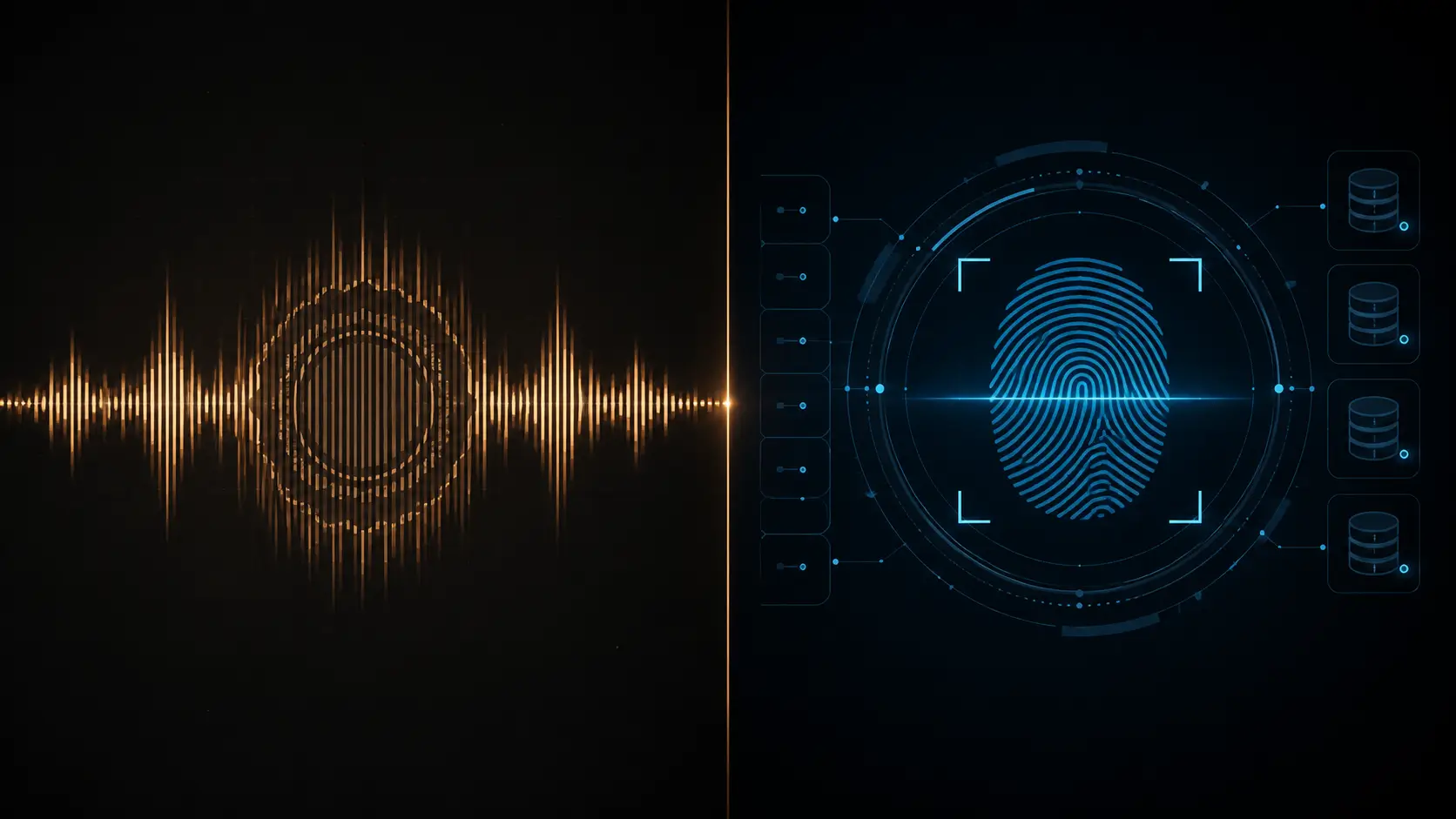
The watermark marks where audio came from. Content ID checks whether audio sounds like something already in its database. Those are completely different questions.
A track with a Suno watermark is not automatically in any rights database. A track without a Suno watermark is not automatically safe from Content ID. The presence or absence of a watermark doesn't change what the audio sounds like — and Content ID only cares about what the audio sounds like.
In other words: the watermark doesn't trigger Content ID, and it doesn't protect you from Content ID either.
Where the actual Content ID risk comes from
The real risk with AI-generated music and Content ID is something different: the possibility that an AI model, trained on copyrighted music, generates output that accidentally shares harmonic or rhythmic patterns with a registered song.
Content ID relies on pattern recognition — audio fingerprinting based on harmonic sequences, rhythmic structures, chord progressions, and drum patterns, not simple waveform comparison. When a lot of people use the same AI tool with similar prompts, the outputs can share detectable patterns, and Content ID may flag them against songs that happen to have similar structures already registered in the database.
This is a real risk that exists independently of any watermarking decision Suno makes. It's about what the audio sounds like — not where it came from.
What actually helps with Content ID
A few things that do matter, based on how Content ID works:
Metadata. Content ID also checks metadata — song title, artist name, composer. If you name your track something that closely matches a registered song, that increases the chance of a flag. Use original titles.
Variety in your prompts. If you're heavily using very common genre descriptors with specific tempo and key combinations that are popular in mainstream releases, you're more likely to accidentally land in territory that's already registered. Varying your style inputs helps.
Dispute the claim if it's wrong. Content ID produces false positives. If your track gets claimed and you generated it yourself, you can dispute the claim through YouTube's process. Document your generation — knowing when and how you made the track is useful if you need to demonstrate origin.
Don't claim copyright you don't have. This one goes the other direction: don't assert copyright over a track as if it's protected, because purely AI-generated audio currently has uncertain copyright status in most jurisdictions. Be honest about what you made.
The sources worth trusting on this
A lot of content about AI music and Content ID is written by services selling "AI detection bypass" tools or promising to make your tracks "Content ID safe." Those services have a financial interest in making this sound more dangerous and more solvable than it is. Be skeptical of any source that makes this sound like a crisis they happen to sell a fix for.
The honest picture: Content ID is an automated system that makes mistakes, affects all music creators (not just AI), and has a dispute process that works when claims are wrong. The Suno watermark is an unrelated transparency measure. Neither of these things is as catastrophic as the most alarming coverage suggests.
The short version
Suno's watermark marks where audio came from — for transparency, disclosure, and tracking. YouTube's Content ID checks whether audio sounds like a registered song — for copyright enforcement. They don't interact. The Content ID risk for AI music comes from the possibility that generated audio accidentally shares patterns with registered songs, not from anything the watermark does or doesn't do.
Related: AI Music Watermarks — What They Are and Why Removing Them Backfire · YouTube and AI Music in 2026 — What Changed and What to Do · How to Distribute AI Music to Streaming Platforms