By Serj · July 2026 · 6 min read
This is not a story about technology. It starts in a hospital bed in East Germany, in 1982 or so, with a twelve-year-old boy who had nothing to do but write.
Where it actually started
When I was twelve I was in a hospital in Jena, East Germany. I'd been injured in an explosion — my father was a Soviet military officer stationed there. I spent a year recovering.
Everyone around me spoke German. I spoke Russian. The only person who could talk to me properly was my doctor, Andrei, who was bilingual. My parents came when they could — about 40 kilometers away, with a younger sister and brother at home they couldn't leave for long. So mostly I was alone.
You find things to do with that kind of time. I started writing poems. Nothing serious — short, funny things, sometimes sharp, sometimes silly, sometimes aimed at specific people in ways that probably weren't entirely kind. I'd read them to whoever was nearby and we'd laugh, or someone would get offended, or both.
I never published them. Never collected them anywhere. Just wrote them, shared them, let them go.
That habit stayed with me for decades. Whenever I found myself with time — in waiting rooms, in hospitals when I went back for various things over the years — I'd write something. Poems about what I observed around me. About people. About situations that seemed absurd or funny or worth capturing.
They went nowhere. That was fine.
Then Suno happened
Somewhere around 2024 I came across Suno on YouTube. Someone was talking about AI music generation. I tried it — just dropped some text in without much thought, no proper prompts, nothing structured.
Something came out that sounded like a song.
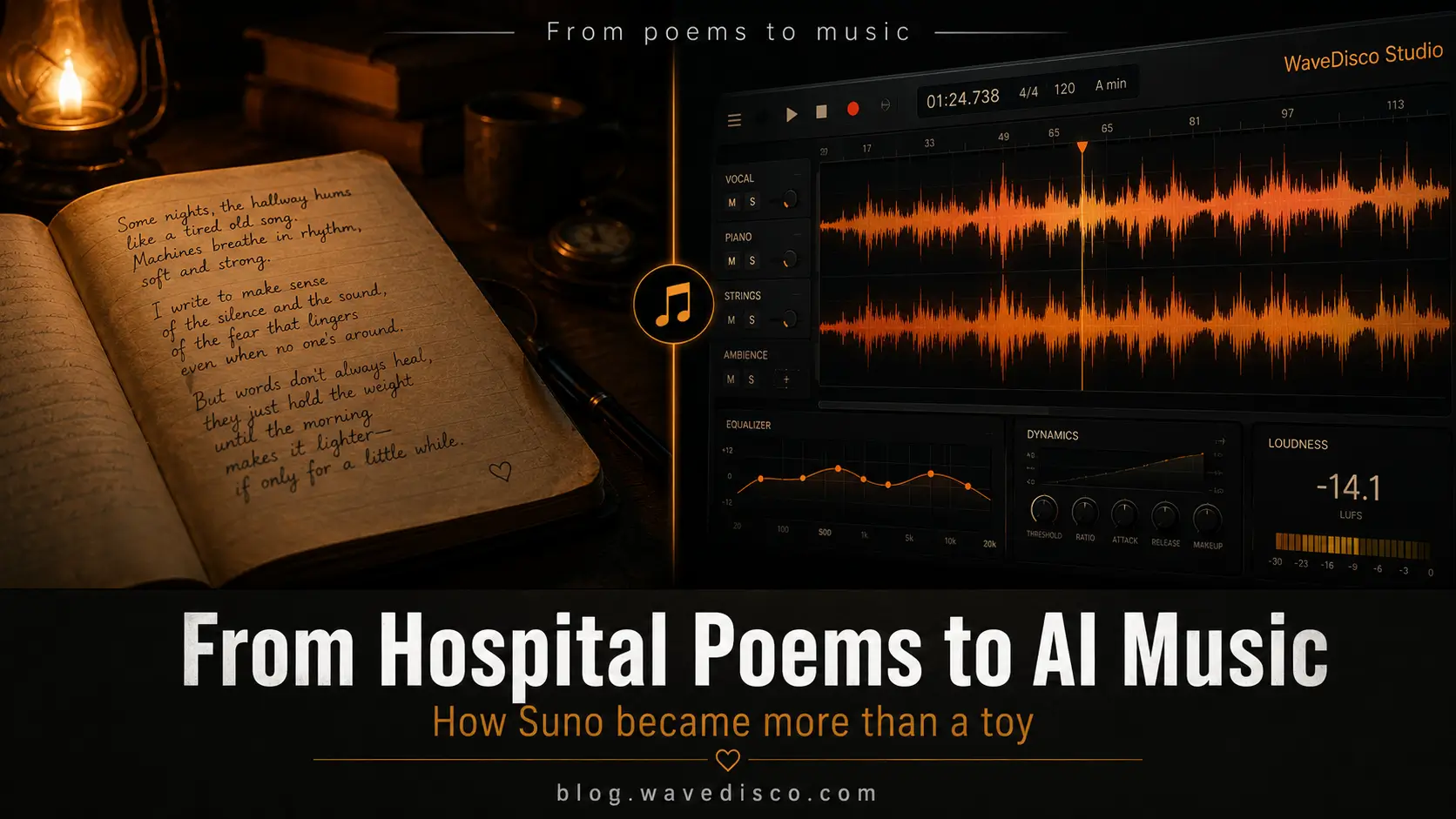
I tried one of my old poems. Suno sang it.
That was a strange moment. These things I'd been writing since I was twelve, that had never gone anywhere, that existed in notebooks and on scraps of paper — suddenly they had a melody. A voice. A beat.
I got interested. Then more interested. Then I started paying for a subscription — around $10 a month — because it stopped feeling like a toy and started feeling like something I actually wanted to do properly.
I opened a YouTube channel. Put the songs up. Some of them did well — a few crossed a million views in the Russian-language segment. One of them was doing particularly well when YouTube decided my thumbnails were too similar to each other. They removed monetization. They kept showing ads on the video. They kept the money those ads generated.
Their platform, their rules. I moved on.
But I noticed something: the songs that did well got copied. Someone would take a song, change three words, reupload it as their own. I'd find my tracks in TikTok clips, in Reels, in YouTube Shorts, credited to strangers. The good ones got copied. The mediocre ones were left alone — which, in a strange way, felt like a quality indicator.
I never registered copyright. I'm not sure I plan to. Suno owns the commercial rights to the output anyway — that's in their terms. And honestly, if people find the songs worth stealing, maybe that's a kind of compliment. The poems existed for decades without reaching anyone. At least now they're somewhere.
The quality problem
As I made more tracks I started noticing the gap between what I heard in Suno's player and what came out on Spotify or YouTube after uploading.
The tracks sounded hot. Harsh on loud moments. Quiet compared to other songs when the platform normalized them. Something was off and I didn't know exactly what.
I started looking for free tools to fix it. There were some. Most had limitations — watermarks, subscriptions, complicated interfaces, things that required accounts and commitments I didn't want to make for something I wasn't sure would work.
I wanted something simple. Drop a file. Get a clean file back. No strings.
I couldn't find exactly that. So I decided to build it.
I want to be clear about what that means in my case. I'm not a developer. I work in retail — I'm a cashier. I had no background in audio engineering or web development. What I had was time in the evenings, Claude as a coding partner, and enough stubbornness to keep going when things didn't work.
Six months later, WaveDisco Studio went live.
What it does and what it doesn't
WaveDisco Studio normalizes loudness to streaming platform targets, applies true peak limiting to catch clipping, and exports clean 24-bit WAV files. Free, in the browser, no account required.
It doesn't transform a bad track into a good one. It doesn't fix creative problems. What it does is handle the technical gap between what AI generators export and what streaming platforms expect — that specific, fixable problem that I ran into and couldn't find a simple free solution for.
I built it for myself. Then I thought other people probably have the same problem. So I made it available.
If it helps you — good. If something about it doesn't suit your needs — that's completely fair. Try it and see.
Still writing
I still write poems. At work when there's a quiet moment. On the bus. Wherever time appears.
Suno is still there when I want to give them a voice. The channel is still up — smaller than it was, but still there. Some songs still get copied by strangers, which means some songs are still good enough to be worth taking.
Not a bad outcome for a habit that started in a hospital bed in East Germany when I was twelve years old and had nothing else to do.
Related: How a Cashier Built an Audio Studio in 6 Months · Free AI Music Mastering Tool · Suno Mastering Online